Buy massivhaus.info ?
We are moving the project
massivhaus.info .
Are you interested in purchasing the domain
massivhaus.info ?
domain@kv-gmbh.de · 0541-91531010
Buy massivhaus.info ?
How does the 3D Zephyr measurement work?
The 3D Zephyr measurement works by using a combination of sensors and algorithms to capture and analyze the movement of an object in three dimensions. The sensors track the position and orientation of the object in real time, while the algorithms process this data to create a 3D model of the object's movement. This allows for precise measurement and analysis of the object's motion in three-dimensional space. **
What is better: the 3D scanner Pop 2 or the software 3DF Zephyr?
The 3D scanner Pop 2 and the software 3DF Zephyr serve different purposes and have different strengths. The Pop 2 is a physical device that captures 3D scans of objects, while 3DF Zephyr is a software that processes and reconstructs 3D models from images. The choice between the two would depend on the specific needs and preferences of the user. If someone needs to capture 3D scans of physical objects, the Pop 2 scanner would be the better choice. On the other hand, if someone needs to work with 3D models from images, 3DF Zephyr would be the better option. **


Similar search terms for Zephyr-Thylacine-Extinct-The
Top-Angebote
Products related to Zephyr-Thylacine-Extinct-The:
-
Zephyr Rosie the Perfect Pony (Pippa's Pony Tales) by Pippa FunnellDescription. Title:. Rosie the Perfect Pony (Pippa's Pony Tales). Condition: BRAND NEW. Format: Paperback. ISBN: 9781804542903. Every waking moment is about horses for pony-mad Tilly. She lives and breathes pony books and magazines and at night she dreams of ponies. At Silver Shoe Farm she is getting to know Magic Spirit better and better and growing in confidence with him. She's also enjoying making new friends both human and, with the arrival of Rosie, the perfect pony, animal ones too.. Collect all 18 titles in this series of irresistible, uplifting and heartwarming pony adventures. Printed in a dyslexia friendly font and packed with up to date tips from three times Olympic Medallist, Pippa Funnell, as well as a helpful glossary and black and white illustrations on every spread.. About The Author:. Philippa Rachel Funnell MBE (née Nolan; born 7 October 1968) is an equestrian sportswoman who competes in eventing. In 2003, she became the first person to win the Rolex Grand Slam of Eventing (consecutive wins at Rolex Kentucky, Badminton and Burghley). She also won Badminton in 2002 and 2005. At the European Championships, she has won two Individual golds (1999–2001) and three team golds (1999–2003). She is a three-time Olympic medallist, winning team silver in 2000 and 2004, and an individual bronze in 2004. She also competed at the 2016 Summer Olympics.. Title. Rosie the Perfect Pony (Pippa's Pony Tales) by Pippa Funnell. Delivery. Content. Reviews5,99 £*Shipping: 2,99 £Secure redirect to the provider
-
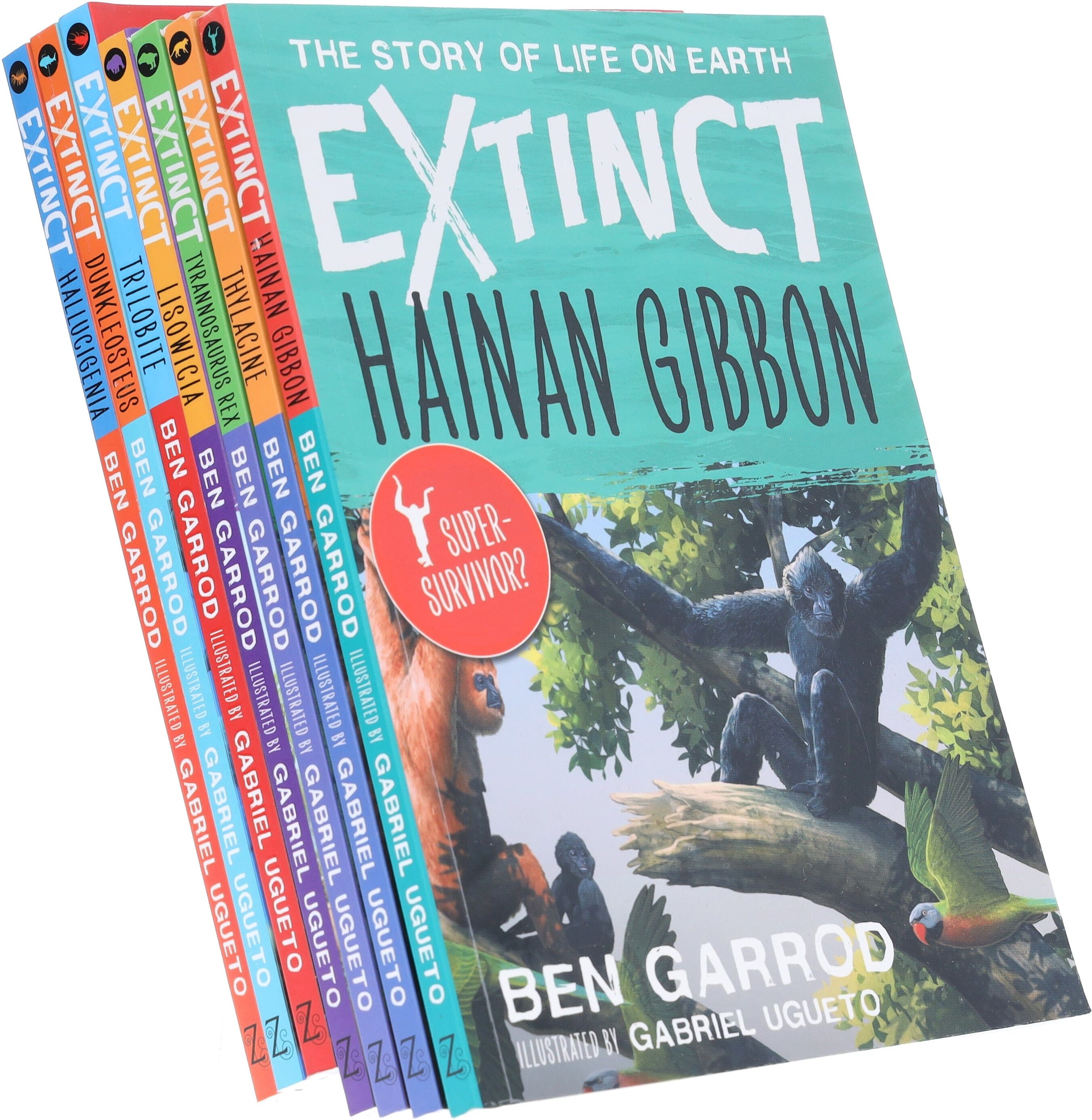
Extinct: The Story of Life on Earth Series by Ben Garrod 7 Books Collection Set - Non Fiction - Paperback Head of ZeusTV scientist Ben Garrod presents the biggest extinction events ever, told from the point of view of evolution's superstars, the most incredible animals ever to swim, stalk, slither or walk our planet. Whether you're 9 or 90, his unique exploration of the most destructive, yet most creative, force in nature makes top level science fun. Titles in this Set: 1. Hallucigenia 2. Dunkleosteus 3. Trilobite 4. Lisowicia 5. Tyrannosaurus Rex 6. Thylacine 7. Hainan Gibbon Description: Hallucigenia Here are the superstars of the story of life, from the super-weird to the super-ferocious. Usually a species has 10 million years or so of evolving, eating, chasing, playing, maybe doing homework, or even going to the moon before it goes extinct. Hallucigenia was a super-weird, spiky, armoured worm that lived 450 million years ago. Scientists were, at first, unsure of which way round it went, and which way up. But here you will discover all Hallucigenia's secrets: where it lived, what it ate, why it was so weird and why it is so important in the story of life. Dunkleosteus Dunkleosteus was super-snappy. With a bite 10 times stronger than a great white shark, it could snap its jaws 5 times faster than you can blink! Discover its habitat, what it ate and what it was like to live in the shadow of this one-tonne predator until it went extinct at the end of the Age of Fishes. Trilobite Trilobite was a super-invader with its stomach in its head. 20,000 species of them survived over millions of years and even through two mass extinctions. Discover the secrets of these successful super-invaders and the Great Dying event which finally eliminated them 250 million years ago. Lisowicia Lisowicia was super-sized. Weighing in at 9 tonnes, it was one of the largest animals roaming the planet during the Late Triassic. It was a kind of cross between a reptile and a mammal, but not quite either! What did Lisowicia eat, how and where did it live and what caused the complete disappearance of this animal which lay undiscovered for over 200 million years? Tyrannosaurus Rex Tyrannosaurus rex, the most famous and the most misunderstood superstar in the story of life! This mightiest of dinosaurs – massive, green and scaly – or, as we now know, massive and partially feathered, with a keen sense of hearing, smell and great vision dominated the Cretaceous landscape. Everyone knows about the giant asteroid which struck Earth 66 million years ago ending the Age of the Dinosaurs. Or did it? Thylacine Thylacine was super-hunted. Wiped out by humans. The last wild thylacine was shot in 1930, and the last captive one died in 1936. We humans are the only species with the power to eliminate other species from the story of life. But who are the winners and losers? Hainan Gibbon Can we make the Hainan gibbon a super-survivor? It's one of our closest living relatives and among the most endangered animals on our planet. Can we change our role in the story of life, from being super-careless to being...16,99 £*Shipping: 2,99 £Secure redirect to the provider
-
Plus Size Women's The Balconette - Mesh by CUUP in Zephyr (Size 36 E)The It-girl bra designed to be seen, the Balconette is a bold style statement. Wide-set straps and a straight neckline iconically frame, flatter, and shape. STYLE NOTES Wide-set straps and a straight neckline create a flattering effectFlexible,...68,00 $*Shipping: 0,00 $Secure redirect to the provider
-
Plus Size Women's The Balconette - Mesh by CUUP in Zephyr (Size 36 F)The It-girl bra designed to be seen, the Balconette is a bold style statement. Wide-set straps and a straight neckline iconically frame, flatter, and shape. STYLE NOTES Wide-set straps and a straight neckline create a flattering effectFlexible,...68,00 $*Shipping: 0,00 $Secure redirect to the provider



-
Are ravens extinct?
No, ravens are not extinct. They are widespread and can be found in various habitats across the Northern Hemisphere. Ravens are known for their intelligence and adaptability, which has helped them survive and thrive in different environments. **
-
Will the pug become extinct?
It is unlikely that pugs will become extinct in the near future. Pugs are a popular breed with a dedicated fan base, which helps ensure their continued breeding and preservation. However, it is important for breeders to prioritize the health and well-being of pugs to prevent any potential risks to their population in the long term. **
-
Will the pug go extinct?
It is unlikely that pugs will go extinct in the near future. While pugs do face health issues due to their breeding, there are efforts being made to address these concerns through responsible breeding practices and increased awareness. Pugs remain a popular breed among dog lovers, which helps ensure their continued existence. **
-
Is the tie finally extinct?
The tie is not extinct, but its popularity has declined in recent years. Many workplaces have adopted more casual dress codes, leading to a decrease in the need for ties. Additionally, the rise of remote work and video conferencing has further reduced the demand for ties. However, the tie still holds a place in formal and professional settings, and many people continue to wear them for special occasions or to make a fashion statement. Overall, while the tie may not be as ubiquitous as it once was, it is not completely extinct. **


Have the Neanderthals become extinct?
Yes, Neanderthals are believed to have become extinct around 40,000 years ago. They were a species of ancient humans that lived in Europe and parts of Asia. While there is evidence of some interbreeding between Neanderthals and modern humans, the Neanderthals themselves are no longer a distinct population. **
Have the Assyrians become extinct?
No, the Assyrians have not become extinct. While their ancient empire no longer exists, there are still Assyrian people living in various parts of the world, including Iraq, Syria, Turkey, and the diaspora in other countries. They continue to maintain their cultural and ethnic identity, language, and traditions, despite facing challenges and persecution in some regions. The Assyrian people are working to preserve their heritage and ensure their continued existence as a distinct community. **
Top-Angebote
Products related to Zephyr-Thylacine-Extinct-The:
-
Zephyr Thylacine Extinct The Story Of Life On Earth By Ben Garrod - Non Fiction - PaperbackTitle: Thylacine: Extinct? The Story of Life on Earth. Format: Paperback Overview:. Browse the shelves of natural history and find a compelling conversation about loss and renewal. Thylacine: Extinct? The Story of Life on Earth invites you to explore one of the most iconic lost species through the lens of a world-class expert. Ben Garrod guides readers through the dramatic rise and fall of the thylacine, also known as the Tasmanian tiger. He reveals how a once widespread mammal vanished from mainland Australia and eventually succumbed to extinction in the wild.. This is not simply a eulogy for a creature that roamed ancient landscapes. Instead, the book uses the thylacine's journey as a powerful window into the broader story of life on our planet. Readers discover how evolutionary paths branch, why ecosystems collapse under pressure, and what signals extinction leaves behind for future generations. The narrative moves beyond tragedy to examine urgent questions about biodiversity, adaptation, and human responsibility.. You will encounter the latest research on resurrection ecology and genetic restoration. The text balances rigorous science with an accessible voice, making complex topics feel personal and immediate. Whether you are curious about marsupials or eager to understand the mechanisms that drive biological change, this work offers a thought-provoking tour of our shared planetary heritage. Discover why the thylacine remains relevant and how its legacy shapes our current understanding of survival and resilience.. Garrod challenges the finality of the term "extinct" by investigating whether modern technology could ever bring back elements of the species. He connects every chapter to universal themes of how life persists against odds. From microscopic adaptations to vast continental shifts, the thylacine serves as the anchor for larger discussions about environmental stewardship. By tracing the thylacine's fossil records, colonial impacts, and captive days, the book builds a rich tapestry of ecological insight. You gain a deeper appreciation for the intricate web of species interactions that sustain our world today. This perspective encourages active engagement with saving the fragile habitats we still possess. What Makes This Book Stand Out:. Standout qualities emerge from the seamless blend of emotional resonance and scientific precision. Ben Garrod brings a rare ability to translate heavy ecological data into gripping narratives that captivate both professionals and casual readers. Unlike dry academic texts, this biography of a species pulses with urgency and wonder. The inclusion of firsthand observations and field experiences adds authenticity that textbooks rarely achieve.. The book excels at connecting local stories to global issues. You will see how the fate of the thylacine mirrors threats faced by countless other endangered animals across the globe. This parallel thinking transforms the reading experience into a practical guide for...10,99 £*Shipping: 2,99 £Secure redirect to the provider
-
Extinct: The Story of Life on Earth 6 Books Collection Set by Ben Garrod - Non Fiction - PaperbackTitles in This Set:. Extinct: Thylacine. Extinct: Hainan Gibbon. Extinct: Dunkleosteus. Extinct: Tyrannosaurus Rex. Extinct: Hallucigenia. Extinct: Lisowicia. Format: Paperback. Overview:. Dive into the fascinating world of extinct species with the Extinct: The Story of Life on Earth 6 Books Collection Set by acclaimed author Ben Garrod. This captivating non-fiction series brings together six individual volumes, each dedicated to a unique prehistoric creature, offering young readers an immersive journey through Earth's ancient history. From the elusive Thylacine to the mighty Tyrannosaurus Rex, this set explores the lives, habitats, and mysteries surrounding these vanished animals, blending scientific facts with engaging narratives. Written in an accessible and enthusiastic tone, it's perfect for budding palaeontologists aged 7 and up, making complex concepts like evolution and extinction both understandable and exciting. Buying this complete collection provides exceptional value, as it allows children to follow the thread of discovery across books, encouraging repeated reading and deeper learning. Whether you're seeking an educational resource for home or school, this set stands out as a comprehensive introduction to natural history, all packaged in sturdy paperback editions that are easy to handle and collect.. What Makes This Collection Special:. What truly sets the Extinct: The Story of Life on Earth collection apart is its seamless blend of scientific accuracy and storytelling flair, creating an emotional pull that turns learning into an adventure. Each book is interconnected through Ben Garrod's consistent narrative style, featuring recurring themes like adaptation, environmental change, and the fragility of life, which build a progressive reader journey from one volume to the next. This binge-read appeal means kids can dive deep into the series, fostering a sense of continuity as they encounter how different species interconnect in the web of evolution. The educational benefits are profound, with vivid illustrations, real fossil evidence, and thought-provoking questions that encourage critical thinking and curiosity about the natural world. Beyond that, it's a fantastic gifting option for parents and educators, offering collectability with its uniform paperback design that looks great on a bookshelf. This collection not only entertains but also instills a lasting appreciation for conservation, making it more than just books—it's a gateway to understanding our planet's past and inspiring action for its future.. Books Included in This Collection:. Extinct: Thylacine. Delve into the shadowy world of the Thylacine, or Tasmanian Tiger, in this engaging book that uncovers the story of Australia's last marsupial predator. Ben Garrod explores how human encroachment led to its extinction, blending historical accounts with scientific insights into its biology and behaviour. With striking visuals and interactive elements, it's an eye-opener for kids...18,99 £*Shipping: 2,99 £Secure redirect to the provider
-
Zephyr Rosie the Perfect Pony (Pippa's Pony Tales) by Pippa FunnellDescription. Title:. Rosie the Perfect Pony (Pippa's Pony Tales). Condition: BRAND NEW. Format: Paperback. ISBN: 9781804542903. Every waking moment is about horses for pony-mad Tilly. She lives and breathes pony books and magazines and at night she dreams of ponies. At Silver Shoe Farm she is getting to know Magic Spirit better and better and growing in confidence with him. She's also enjoying making new friends both human and, with the arrival of Rosie, the perfect pony, animal ones too.. Collect all 18 titles in this series of irresistible, uplifting and heartwarming pony adventures. Printed in a dyslexia friendly font and packed with up to date tips from three times Olympic Medallist, Pippa Funnell, as well as a helpful glossary and black and white illustrations on every spread.. About The Author:. Philippa Rachel Funnell MBE (née Nolan; born 7 October 1968) is an equestrian sportswoman who competes in eventing. In 2003, she became the first person to win the Rolex Grand Slam of Eventing (consecutive wins at Rolex Kentucky, Badminton and Burghley). She also won Badminton in 2002 and 2005. At the European Championships, she has won two Individual golds (1999–2001) and three team golds (1999–2003). She is a three-time Olympic medallist, winning team silver in 2000 and 2004, and an individual bronze in 2004. She also competed at the 2016 Summer Olympics.. Title. Rosie the Perfect Pony (Pippa's Pony Tales) by Pippa Funnell. Delivery. Content. Reviews5,99 £*Shipping: 2,99 £Secure redirect to the provider
-
Extinct: The Story of Life on Earth Series by Ben Garrod 7 Books Collection Set - Non Fiction - Paperback Head of ZeusTV scientist Ben Garrod presents the biggest extinction events ever, told from the point of view of evolution's superstars, the most incredible animals ever to swim, stalk, slither or walk our planet. Whether you're 9 or 90, his unique exploration of the most destructive, yet most creative, force in nature makes top level science fun. Titles in this Set: 1. Hallucigenia 2. Dunkleosteus 3. Trilobite 4. Lisowicia 5. Tyrannosaurus Rex 6. Thylacine 7. Hainan Gibbon Description: Hallucigenia Here are the superstars of the story of life, from the super-weird to the super-ferocious. Usually a species has 10 million years or so of evolving, eating, chasing, playing, maybe doing homework, or even going to the moon before it goes extinct. Hallucigenia was a super-weird, spiky, armoured worm that lived 450 million years ago. Scientists were, at first, unsure of which way round it went, and which way up. But here you will discover all Hallucigenia's secrets: where it lived, what it ate, why it was so weird and why it is so important in the story of life. Dunkleosteus Dunkleosteus was super-snappy. With a bite 10 times stronger than a great white shark, it could snap its jaws 5 times faster than you can blink! Discover its habitat, what it ate and what it was like to live in the shadow of this one-tonne predator until it went extinct at the end of the Age of Fishes. Trilobite Trilobite was a super-invader with its stomach in its head. 20,000 species of them survived over millions of years and even through two mass extinctions. Discover the secrets of these successful super-invaders and the Great Dying event which finally eliminated them 250 million years ago. Lisowicia Lisowicia was super-sized. Weighing in at 9 tonnes, it was one of the largest animals roaming the planet during the Late Triassic. It was a kind of cross between a reptile and a mammal, but not quite either! What did Lisowicia eat, how and where did it live and what caused the complete disappearance of this animal which lay undiscovered for over 200 million years? Tyrannosaurus Rex Tyrannosaurus rex, the most famous and the most misunderstood superstar in the story of life! This mightiest of dinosaurs – massive, green and scaly – or, as we now know, massive and partially feathered, with a keen sense of hearing, smell and great vision dominated the Cretaceous landscape. Everyone knows about the giant asteroid which struck Earth 66 million years ago ending the Age of the Dinosaurs. Or did it? Thylacine Thylacine was super-hunted. Wiped out by humans. The last wild thylacine was shot in 1930, and the last captive one died in 1936. We humans are the only species with the power to eliminate other species from the story of life. But who are the winners and losers? Hainan Gibbon Can we make the Hainan gibbon a super-survivor? It's one of our closest living relatives and among the most endangered animals on our planet. Can we change our role in the story of life, from being super-careless to being...16,99 £*Shipping: 2,99 £Secure redirect to the provider
-
How does the 3D Zephyr measurement work?
The 3D Zephyr measurement works by using a combination of sensors and algorithms to capture and analyze the movement of an object in three dimensions. The sensors track the position and orientation of the object in real time, while the algorithms process this data to create a 3D model of the object's movement. This allows for precise measurement and analysis of the object's motion in three-dimensional space. **
-
What is better: the 3D scanner Pop 2 or the software 3DF Zephyr?
The 3D scanner Pop 2 and the software 3DF Zephyr serve different purposes and have different strengths. The Pop 2 is a physical device that captures 3D scans of objects, while 3DF Zephyr is a software that processes and reconstructs 3D models from images. The choice between the two would depend on the specific needs and preferences of the user. If someone needs to capture 3D scans of physical objects, the Pop 2 scanner would be the better choice. On the other hand, if someone needs to work with 3D models from images, 3DF Zephyr would be the better option. **
-
Are ravens extinct?
No, ravens are not extinct. They are widespread and can be found in various habitats across the Northern Hemisphere. Ravens are known for their intelligence and adaptability, which has helped them survive and thrive in different environments. **
-
Will the pug become extinct?
It is unlikely that pugs will become extinct in the near future. Pugs are a popular breed with a dedicated fan base, which helps ensure their continued breeding and preservation. However, it is important for breeders to prioritize the health and well-being of pugs to prevent any potential risks to their population in the long term. **
Similar search terms for Zephyr-Thylacine-Extinct-The
-
Plus Size Women's The Balconette - Mesh by CUUP in Zephyr (Size 36 E)The It-girl bra designed to be seen, the Balconette is a bold style statement. Wide-set straps and a straight neckline iconically frame, flatter, and shape. STYLE NOTES Wide-set straps and a straight neckline create a flattering effectFlexible,...68,00 $*Shipping: 0,00 $Secure redirect to the provider
-
Plus Size Women's The Balconette - Mesh by CUUP in Zephyr (Size 36 F)The It-girl bra designed to be seen, the Balconette is a bold style statement. Wide-set straps and a straight neckline iconically frame, flatter, and shape. STYLE NOTES Wide-set straps and a straight neckline create a flattering effectFlexible,...68,00 $*Shipping: 0,00 $Secure redirect to the provider
-
Plus Size Women's The Balconette - Mesh by CUUP in Zephyr (Size 36 G)The It-girl bra designed to be seen, the Balconette is a bold style statement. Wide-set straps and a straight neckline iconically frame, flatter, and shape. STYLE NOTES Wide-set straps and a straight neckline create a flattering effectFlexible,...68,00 $*Shipping: 0,00 $Secure redirect to the provider
-
Plus Size Women's The Balconette - Mesh by CUUP in Zephyr (Size 36 H)The It-girl bra designed to be seen, the Balconette is a bold style statement. Wide-set straps and a straight neckline iconically frame, flatter, and shape. STYLE NOTES Wide-set straps and a straight neckline create a flattering effectFlexible,...68,00 $*Shipping: 0,00 $Secure redirect to the provider
-
Will the pug go extinct?
It is unlikely that pugs will go extinct in the near future. While pugs do face health issues due to their breeding, there are efforts being made to address these concerns through responsible breeding practices and increased awareness. Pugs remain a popular breed among dog lovers, which helps ensure their continued existence. **
-
Is the tie finally extinct?
The tie is not extinct, but its popularity has declined in recent years. Many workplaces have adopted more casual dress codes, leading to a decrease in the need for ties. Additionally, the rise of remote work and video conferencing has further reduced the demand for ties. However, the tie still holds a place in formal and professional settings, and many people continue to wear them for special occasions or to make a fashion statement. Overall, while the tie may not be as ubiquitous as it once was, it is not completely extinct. **
-
Have the Neanderthals become extinct?
Yes, Neanderthals are believed to have become extinct around 40,000 years ago. They were a species of ancient humans that lived in Europe and parts of Asia. While there is evidence of some interbreeding between Neanderthals and modern humans, the Neanderthals themselves are no longer a distinct population. **
-
Have the Assyrians become extinct?
No, the Assyrians have not become extinct. While their ancient empire no longer exists, there are still Assyrian people living in various parts of the world, including Iraq, Syria, Turkey, and the diaspora in other countries. They continue to maintain their cultural and ethnic identity, language, and traditions, despite facing challenges and persecution in some regions. The Assyrian people are working to preserve their heritage and ensure their continued existence as a distinct community. **
* All prices are inclusive of VAT and, if applicable, plus shipping costs. The offer information is based on the details provided by the respective shop and is updated through automated processes. Real-time updates do not occur, so deviations can occur in individual cases. ** Note: Parts of this content were created by AI.